Crossbow Terminology: A Plain-English Glossary
As an Amazon Associate, this site may earn from qualifying purchases. How we make money
In this article
- Parts of a crossbow
- Power and performance terms
- Size and handling terms
- Cocking and safety terms
- Bolt and point terms
- Optics terms
- Crossbow types, in one line each
- Frequently asked questions
- Is a “bolt” different from an “arrow”?
- Why does my crossbow shoot slower than its FPS rating?
- What’s the difference between ATA and cocked width?
Crossbow spec sheets and reviews are full of jargon: power stroke, ATA, FPS, FOC, ADF, grain. If you’re new to crossbows, the terms can make two very different bows look identical, or the same bow sound like two different ones. This glossary explains the words you’ll actually meet when shopping for, setting up and shooting a crossbow, grouped so related terms sit together.
How we put this together: These are the standard industry definitions, as manufacturers use them on spec sheets and in owner’s manuals. Where manufacturers measure something differently (speed ratings in particular), we say so.
Parts of a crossbow
- Stock
- The main body you hold and shoulder, like a rifle stock. Many are adjustable for length of pull and cheek height.
- Barrel / rail
- The top surface the bolt sits on and slides along. The flight groove is the channel in the rail that guides the bolt’s vane. The flight deck is the area the string travels over when the crossbow fires.
- Limbs (prod)
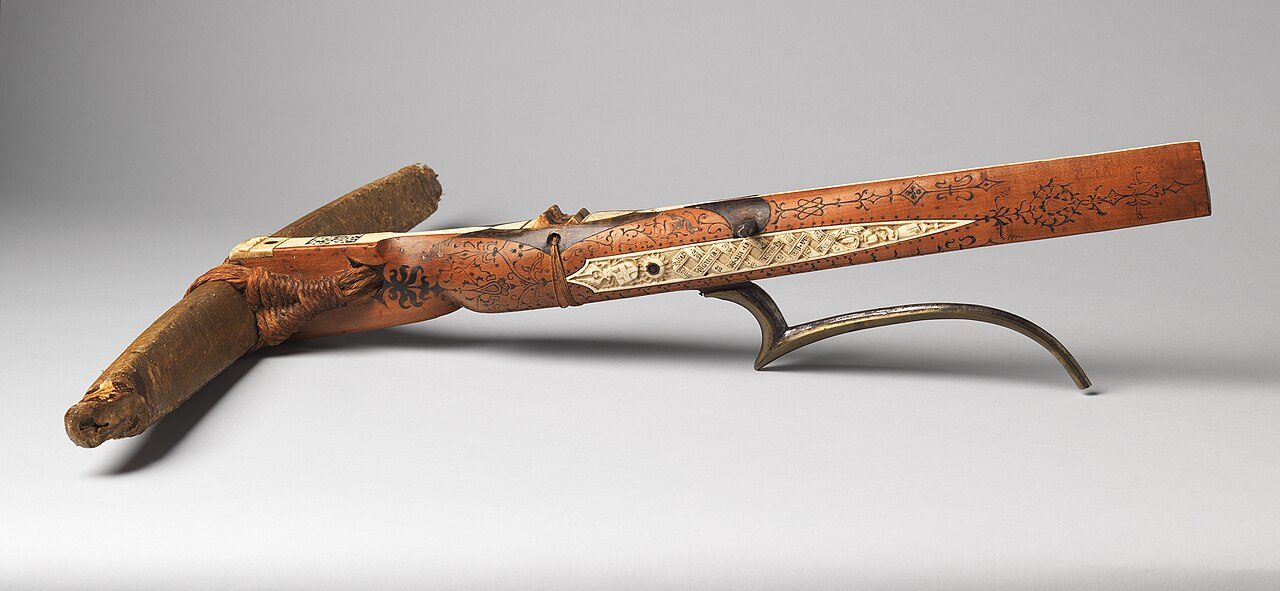
- The flexible arms at the front that store energy when the string is drawn. “Prod” is the traditional name, still used for one-piece limbs and historic crossbows.
- Riser
- The central block the limbs attach to at the front of the crossbow.
- Cams / wheels
- The pulleys at the limb tips on compound crossbows. They give a mechanical advantage that lets shorter limbs store more energy.
- String and cables
- The string launches the bolt. On compound crossbows, the cables connect the cams to the limbs. Serving is the extra wrapping on the parts of the string that take wear.
- Foregrip and finger guard
- The front grip for your supporting hand. The finger guard (or flange) is there to keep your fingers out of the string’s path. Always keep them below the rail.
- Trigger and trigger box
- The mechanism that holds the string when cocked and releases it. Trigger pull is the force needed to fire, usually given in pounds.
- Stirrup
- The loop at the front you put your foot in while cocking by hand or with a rope cocker.
- Picatinny / Weaver rail
- Standard mounting rails for scopes and accessories.
Power and performance terms
- Draw weight
- The force needed to pull the string back to the cocked position, in pounds. Higher draw weight usually means more stored energy, but also harder cocking.
- Power stroke
- The distance the string travels from rest to the cocked position. A longer power stroke can produce more speed at a given draw weight.
- FPS (feet per second)
- Bolt speed. Manufacturer FPS ratings are usually measured with a specific, often light, bolt weight, so real speeds with heavier hunting bolts are typically lower. Compare ratings with care.
- Kinetic energy (KE)
- The energy the bolt carries, in foot-pounds (ft-lbs). The standard formula is bolt weight in grains × FPS² ÷ 450,240. Our kinetic energy guide explains how much you need for different game.
- Momentum
- Mass times velocity. Heavier bolts carry more momentum, which helps penetration and wind resistance even at lower speed.
- Grain (gr)
- The unit used for bolt and point weight. 437.5 grains = 1 ounce.
Size and handling terms
- ATA (axle-to-axle)
- The width between the cam axles on a compound crossbow, uncocked. Some brands quote cocked width instead, which is narrower. Check which one you’re comparing.
- Overall length
- From the front of the limbs to the back of the stock.
- Weight (bare vs. fully equipped)
- “Bare” excludes the scope, quiver and bolts. Fully equipped weight is what you’ll actually carry.
- Length of pull
- The distance from the trigger to the end of the butt stock. Adjustable stocks help smaller shooters fit the crossbow.
Cocking and safety terms
- Rope cocker
- A rope-and-pulley aid that roughly halves the effort of cocking. See rope cocker vs. crank.
- Crank cocking device
- A winch that draws the string with very little effort. Some are built into the stock.
- ADF (anti-dry-fire)
- A mechanism that stops the crossbow firing unless a bolt is properly seated.
- Auto-safety
- A safety that engages automatically when you cock the crossbow.
- Dry fire
- Releasing the string with no bolt loaded. It can seriously damage the crossbow; never do it.
- Decocking
- Safely releasing a cocked crossbow, usually by shooting a decocking bolt into a target. See how to uncock a crossbow.
Bolt and point terms
- Bolt (arrow)
- The projectile. Crossbow “bolts” and “arrows” mean the same thing; many manufacturers now say arrows.
- Nock
- The rear end that contacts the string. Common styles are half-moon (must be oriented correctly) and flat or capture nocks. Use the type your manufacturer specifies. Lighted nocks glow on release so you can follow the shot.
- Vanes / fletching
- The fins that stabilise the bolt in flight.
- Spine and straightness
- Spine is stiffness. Straightness tolerance (for example ±.003″) is how true the shaft is; tighter is more consistent.
- FOC (front of centre)
- How far forward of the middle the bolt’s balance point sits, as a percentage. Higher FOC tends to fly and penetrate better.
- Insert
- The threaded piece glued into the front of the shaft that points screw into.
- Field point
- A simple practice point. Use field points only on bag targets.
- Broadhead
- A bladed hunting point. Fixed broadheads have exposed blades; mechanical (expandable) ones open on impact. Cutting diameter is the width of the cut. See our broadhead guide.
Optics terms
- Reticle
- The aiming marks in the scope. Multi-reticle or “multi-line” scopes give aim points for several distances (often 20–60 yards in 10-yard steps).
- Speed-adjustable scope
- A scope you can calibrate to your crossbow’s actual speed so the reticle lines match real distances.
- Parallax
- Apparent movement of the reticle against the target when your eye shifts. Some scopes let you adjust it for a given range.
- Zeroing / sighting in
- Adjusting the scope so the bolt hits where the reticle points. See how to sight in a crossbow.
Crossbow types, in one line each
- Recurve: simple limbs with no cams; wider, easy to maintain.
- Compound: cams and cables; narrower and often faster.
- Reverse-draw: limbs point backwards for a more compact, balanced bow.
- Pistol crossbow: small, low-power, mostly for target fun.
Our crossbow types guide covers each in depth.
Frequently asked questions
Is a “bolt” different from an “arrow”?
For crossbows, no. Both words mean the projectile. “Bolt” is traditional, and many manufacturers now call them crossbow arrows.
Why does my crossbow shoot slower than its FPS rating?
Ratings are usually measured with a specific bolt weight, often lighter than typical hunting bolts. A heavier bolt flies slower but carries more momentum.
What’s the difference between ATA and cocked width?
ATA is measured uncocked, between the cam axles. Cocked width is measured with the string drawn, when the limbs are flexed inward, so it’s smaller.